How Aircraft Autopilot Really Works: The Technology Flying Above You
Behind every automated turn, altitude adjustment and carefully controlled approach is a system that measures, calculates and corrects the aircraft's movement.
Imagine sitting beside the window at 35,000 feet. The aircraft appears to fly smoothly by itself. The pilots are monitoring instruments, communicating with air traffic control and checking the flight's progress. So, if nobody is constantly moving the controls, what is keeping the airplane on course?
The answer is autopilot: a sophisticated system that can control selected aspects of an aircraft's movement using computers, sensors and control mechanisms. It is not a robot sitting in the cockpit, and it does not simply follow a route blindly. It repeatedly measures what the aircraft is doing, compares that information with what it has been commanded to do, and makes corrections when necessary.
1. The three essential parts of autopilot
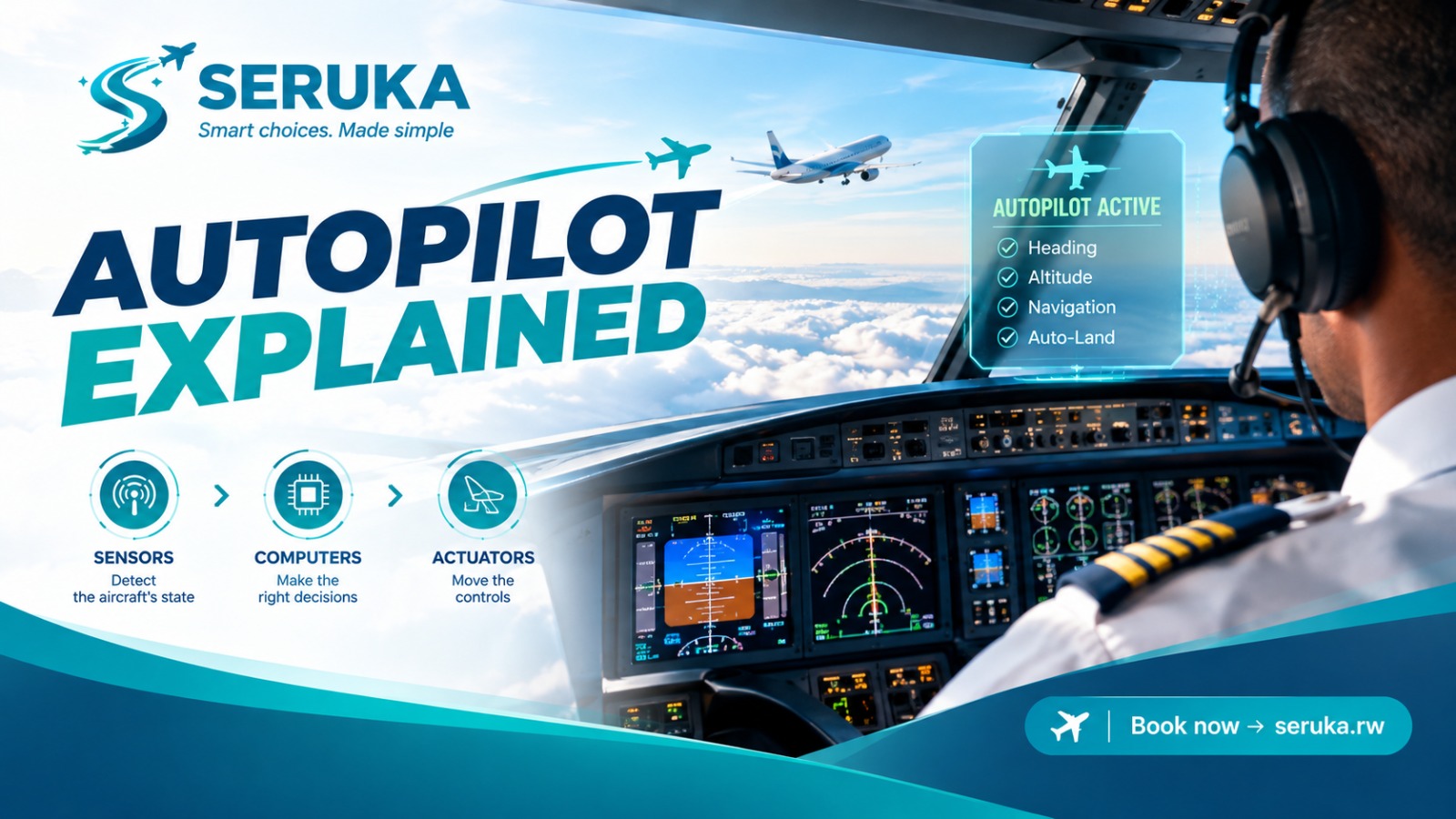
Although aircraft systems vary, the basic principle can be understood through three functions: sensing the aircraft's condition, calculating the required response, and moving the controls.
Measure the aircraft's attitude, movement, altitude, speed and position using different instruments and data sources.
Compare measured conditions with the selected targets and calculate the corrections needed.
Move the relevant flight controls through electric, hydraulic or other aircraft-specific mechanisms.
2. How does the aircraft know what it is doing?
Autopilot needs reliable information before it can make a useful correction. Different sensors and aircraft systems supply different pieces of the picture.
Inertial reference systems
Inertial reference systems use sensors such as gyroscopes and accelerometers to estimate the aircraft's orientation and movement. They help determine whether the aircraft is pitching its nose up or down, rolling to one side, or changing its motion. Depending on the equipment, inertial data also contributes to navigation calculations.
Air-data instruments
Pitot and static pressure measurements help provide airspeed, altitude and vertical-speed information. These measurements matter because an aircraft's behaviour depends on its speed, altitude and surrounding air conditions. Modern systems process these measurements electronically and check their validity.
Navigation sources
GPS and other navigation systems help determine the aircraft's position and progress along a route. Radio-navigation signals, such as those from VOR stations, can also provide navigation information. For an instrument landing, specialised receivers may use signals from an Instrument Landing System (ILS).
3. The brain: who decides what the aircraft should do?
This is where the terminology can become confusing. The Flight Management System (FMS) helps manage the planned route, navigation, performance calculations and other flight tasks. It can provide targets or guidance for the autopilot, but it is not the same thing as the entire autopilot or flight-control system.
The autopilot and associated flight-control computers use sensor information and selected modes to control the aircraft toward a target. For example, a pilot might select a particular altitude or instruct the system to follow a navigation path. The relevant computers then calculate how the aircraft should respond.
Imagine the aircraft is commanded to maintain a particular altitude. If it begins to drift below that target, the system detects the difference and can command a pitch adjustment. As the aircraft approaches the selected altitude, the control system adjusts its response to avoid excessive correction.
This process happens repeatedly. It is not a single instruction followed by a long period of inaction; the system continuously updates its response as the aircraft and surrounding conditions change.
4. The muscles: how computers move an aircraft
Computers cannot physically turn an airplane by themselves. They must send commands to actuators that operate the flight controls.
Depending on the aircraft's design, these mechanisms can involve electric motors, hydraulic actuators or electronically controlled flight-control systems. They move the relevant surfaces to change the aircraft's motion.
Ailerons: controlling roll
Ailerons help control roll, the movement that tilts the wings to one side or the other. When the aircraft needs to turn, controlling its bank angle is an important part of the manoeuvre.
Elevators or other pitch controls
These controls change the aircraft's pitch, meaning the direction its nose points up or down. Pitch control helps the aircraft maintain altitude, climb or descend, depending on the selected mode and flight conditions.
Rudder and thrust
The rudder controls yaw, or the aircraft's nose movement left and right. Some autopilot and flight-guidance functions also coordinate with other systems, including automatic thrust control where installed, to maintain a desired speed or meet flight targets.
Not every autopilot controls every one of these functions in every mode. Its capabilities depend on the aircraft, installed equipment and the mode selected by the pilots.
5. The feedback loop: how autopilot corrects mistakes
Consider a crosswind pushing the aircraft away from its intended route. The autopilot compares the aircraft's measured progress with the desired path. When the system detects a deviation, it calculates a response and commands the controls to bring the aircraft back toward the target.
Once the aircraft responds, its sensors measure the new condition. The computer checks the result and adjusts again if necessary. This cycle of measurement, comparison and correction is called a closed-loop control system.
The system does not simply force the airplane to point in the direction of its destination. Wind, aircraft speed, turns and other flight conditions affect the correct response. The goal is to control the aircraft's movement so it follows the selected targets within the system's operating limits.
6. The main autopilot modes explained
Heading and altitude hold
Heading hold helps maintain a selected heading, while altitude hold helps maintain a selected altitude. These are separate functions, and the exact behaviour depends on the aircraft and mode. Maintaining a heading does not automatically mean the aircraft is following a planned route over the ground, especially when wind is present.
Navigation mode
Navigation modes allow the aircraft to follow guidance from a selected route or navigation source. Depending on the system, that may include a flight-management route, GPS-based guidance or radio-navigation signals. The aircraft can make turns along the route without the pilots having to steer manually through every change of direction.
Vertical navigation and descent
Some systems can follow vertical profiles, manage climbs and descents, or capture a selected altitude. More advanced functions can coordinate lateral navigation, vertical guidance and speed management. Pilots still need to confirm that the chosen modes and targets are appropriate for the clearance, weather and aircraft situation.
Autoland
Autoland is a specialised capability that can automatically guide a suitably equipped aircraft through an approach and landing under approved conditions. Many systems use an Instrument Landing System (ILS), which provides localiser guidance for alignment with the runway and glideslope guidance for the descent path. The aircraft's onboard equipment follows these signals and controls the flight path.
Autoland is not available on every aircraft or every runway. The aircraft, airport facilities, approach, weather conditions and operating procedures must all support its use. Some systems can also provide automatic rollout guidance after touchdown, but the capability varies.
7. Does autopilot mean pilots are no longer needed?
Absolutely not. Autopilot is an aid to flight management, not a replacement for the flight crew. Pilots plan and monitor the flight, communicate with air traffic control, manage changing conditions, verify system modes and respond when something does not behave as expected.
They also decide when automation is appropriate and when manual control is necessary. If a situation requires it, the autopilot can be disconnected using the aircraft's designated controls, and pilots can take over manually. The exact procedures depend on the aircraft.
Even when the autopilot is engaged, the crew must understand what the system is doing. A selected mode may not produce the result a pilot expects if the wrong target or mode has been entered. That is why monitoring the flight instruments and confirming mode changes are essential parts of safe operation.
8. What happens if the autopilot fails?
Aircraft are designed with procedures for dealing with automation failures. Depending on the aircraft, a fault may trigger an alert, cause a function to disconnect or lead the system to revert to a different level of capability. Pilots are trained to recognise these situations and continue flying using the remaining available systems or manual controls.
A failure of the autopilot does not automatically mean that the aircraft has lost the ability to fly. The autopilot is one part of a much larger aircraft system. The crew follows the applicable procedures, assesses what equipment remains available and controls the aircraft accordingly.
The takeaway
Aircraft autopilot is best understood as a continuous conversation between sensors, computers and flight controls. Sensors measure the aircraft's condition, computers compare it with the intended flight path, and actuators make the necessary adjustments.
From holding altitude to following a navigation route or conducting a supported automatic landing, each function depends on specific equipment and operating conditions. The technology can reduce the workload of flying, but it works alongside trained pilots who remain responsible for monitoring the aircraft and managing the flight.
The next time you look out of an airplane window and see a smooth, steady horizon, remember: the aircraft may be making hundreds of small control adjustments while the pilots supervise the journey.
Federal Aviation Administration (FAA)
European Union Aviation Safety Agency (EASA)
SKYbrary Aviation Safety
Your next journey starts here
Ready to plan your next trip? Explore flight options and make your travel plans with Seruka.
Book now → seruka.rw