Bleed Air: The Hidden System That Supplies Air Inside an Airplane
The air you breathe at 35,000 feet has a remarkable journey before it reaches your seat.
You settle into your seat, close the overhead air vent, and prepare for take-off. But have you ever wondered where the air filling the cabin actually comes from? Is it simply the same air being recycled for the entire flight?
Not exactly. Modern commercial aircraft use a carefully engineered ventilation system that combines fresh outside air with filtered air from inside the cabin. On many traditional jet aircraft, an important part of this process begins inside the engines. The technology is called bleed air.
1. Why take air from an engine?
At cruising altitude, the outside atmosphere is extremely cold and thin, with far less pressure than the air needed inside a passenger cabin. The aircraft must continuously supply air at a suitable pressure and temperature while keeping the cabin comfortable.
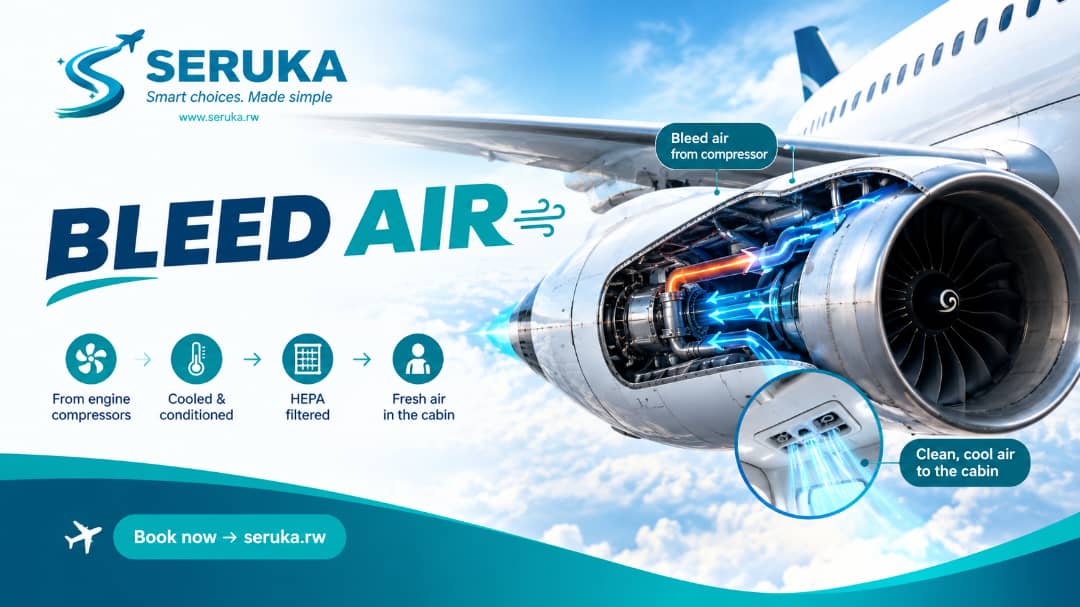
In many jet engines, incoming air passes through compressor stages, where rotating blades raise its pressure and temperature before it reaches the combustion section. Aircraft designers can divert a controlled amount of this compressed air for other purposes, including cabin environmental control. That diverted supply is known as bleed air.
The engine is not sending cabin air from its hot exhaust. Instead, the system takes air from an appropriate compressor stage, upstream of combustion. Valves and controls regulate the supply according to the aircraft's design and operating conditions.
2. From hot compressed air to a comfortable cabin
Air coming from an engine compressor can be far too hot to deliver directly to passengers. The aircraft's environmental control system, often called the ECS, must reduce its temperature and regulate its pressure.
Compressed air is drawn from a designated engine compressor stage or another approved source.
Valves and regulators control the supply and help the system operate within its required limits.
Air-conditioning packs use heat exchangers and air-cycle machinery to cool and condition the air.
Conditioned air is mixed with filtered recirculated cabin air, then distributed through the ventilation system.
In many aircraft, the cooling process uses outside air as a heat sink in heat exchangers. Air-cycle machines then help cool and regulate the supply. The system also manages moisture and pressure so the air delivered to passengers is suitable for the cabin environment.
3. The important difference: fresh air versus filtered air
Here is the detail many explanations miss: HEPA filters generally clean the recirculated cabin air, not the engine bleed air itself. In a typical system, fresh outside air is conditioned, while a portion of cabin air is drawn back through high-efficiency filters before being mixed into the supply again.
Many large commercial aircraft operate with a mix that is approximately half fresh air and half filtered recirculated air, although the actual proportion varies by aircraft type and operating conditions. This arrangement helps maintain cabin air quality while reducing the energy required to condition large amounts of outside air.
4. What does a HEPA filter actually remove?
HEPA stands for High-Efficiency Particulate Air. A properly rated HEPA filter is designed to capture at least 99.97% of particles at the specified test size of 0.3 micrometres. It can capture many airborne particles, including bacteria, and particles or droplets carrying viruses.
But there is an important limitation: a HEPA filter is a particle filter, not a universal chemical filter. Gases and many vapours can pass through it. Some aircraft use additional technologies, such as ozone converters or other filtration systems, to address particular contaminants.
5. How often is the cabin air renewed?
Cabin air is continually supplied and removed. On many modern commercial aircraft, the combined ventilation system renews the cabin air roughly every two to three minutes under typical operating conditions. This does not mean every molecule is replaced at exactly the same time; fresh air, filtered recirculation and exhaust work together continuously.
Air commonly enters the cabin through outlets near the ceiling and moves generally downward toward return or exhaust grilles near the floor. This planned airflow helps remove heat and airborne particles from the occupied space. It also means cabin air is not simply left circulating without treatment.
6. Is airplane cabin air always perfect?
No ventilation system can promise that cabin air is free from every contaminant. Regulators set cabin air standards, and aircraft systems are designed to maintain acceptable conditions during normal operation. However, technical problems can occasionally allow unusual fumes or odours to enter the cabin. These events are uncommon but are taken seriously by airlines and aviation authorities.
It is also important to know that aircraft designs differ. For example, the Boeing 787 uses an electrically driven cabin air-compression architecture rather than conventional engine bleed air for its cabin air supply. So, while the goal of providing properly conditioned cabin air is shared, the engineering method is not identical on every aircraft.
The takeaway
The next time you board a flight, remember that the air reaching your seat has passed through a sophisticated system of pressure control, cooling, mixing and ventilation. On many aircraft, bleed air provides the fresh-air supply; HEPA filters clean much of the recirculated air; and the cabin ventilation system continuously moves air through the aircraft.
It is a small but remarkable piece of aviation engineering: a system designed to make an environment high above the Earth suitable for people to travel in comfort.
Federal Aviation Administration — Cabin Air Quality
Airbus — How the Cabin Air System Works
IATA — Health and Safety
Your next journey starts here
Explore flight options and make your next travel plan with Seruka.
Book now → seruka.rw