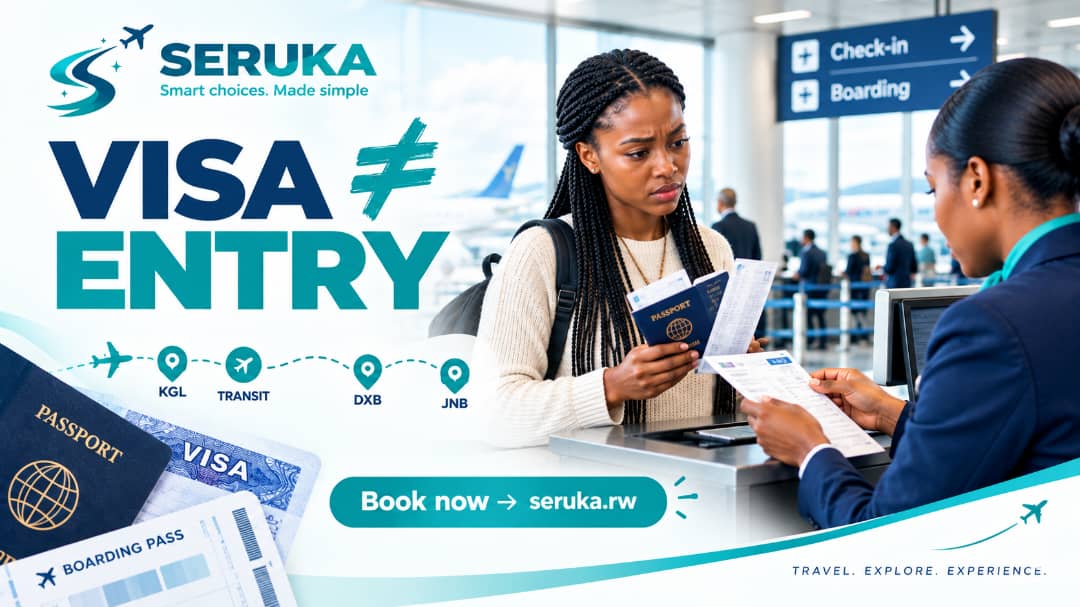
Your Visa Isn't Enough
Imagine arriving at the airport with a valid passport, a valid visa, a confirmed flight and a hotel booking. Everything looks ready. Then the airline agent checks your documents and tells you: you cannot board.
It sounds strange. If the country gave you a visa, shouldn't that mean you are allowed to travel there?
Not necessarily. A visa is an important part of the journey, but it is only one part of the travel requirements. Your itinerary, transit points, passport validity, purpose of travel and other conditions can still matter.
The surprising part is that you may discover the problem before you ever reach immigration at your destination.
Your Destination Visa Isn't the Whole Journey
Consider a traveler flying from Rwanda to a country in Asia with a connection somewhere in the Middle East.
The traveler may have the correct visa for the final destination. But the journey also involves a transit country. Depending on the itinerary, nationality and airport, that transit point can have its own requirements.
This is why checking only the final destination can be misleading. Travel requirements can apply to the entire itinerary, not just where you plan to spend your holiday.
A Valid Visa Can Still Be the Wrong Visa
Another detail travelers often overlook is the purpose of the trip. A visa can be genuine and still not match what the traveler intends to do.
Tourist travel, employment, study and certain business activities can have different immigration requirements. The important question isn't only:
“Is my visa valid?”
It is also:
“Does my visa allow me to travel for this purpose?”
Your Passport Has Rules Too
A passport being unexpired does not automatically mean it satisfies every destination's requirements.
Some countries require a certain amount of passport validity beyond the date of arrival. Other requirements can involve blank pages, specific documentation or additional conditions.
So the question isn't simply whether your passport expires next year. The relevant requirement may depend on when and where you are travelling.
The Airline Checks You Before Immigration Does
This is where the process becomes interesting.
Before you board, the airline has to determine whether your documents satisfy the requirements for your journey. Airlines use travel-document information systems to help verify passport, visa, transit and other requirements.
One system widely used in the industry is IATA's Timatic, which provides travel-document requirements based on factors such as nationality, destination and itinerary.
This doesn't mean the airline is deciding whether you are permanently allowed into the country. Border authorities make the final decision on admission.
But the airline's document check can determine whether you get on the aircraft in the first place.
And Then There Is the Final Decision
Even after successfully boarding your flight, entry is still determined by the authorities at your destination.
A visa generally allows a traveler to seek entry under the conditions attached to that visa. It does not remove the authority of border officials to assess whether the traveler meets the country's requirements when they arrive.
Airline: Can this passenger be carried to the
destination under the applicable travel-document rules?
Border control: Does this traveler meet the
conditions for entry?
Before You Book, Check More Than the Visa
Before paying for a ticket, especially when your journey includes connections, check the complete itinerary and the requirements that apply to your nationality.
- Passport validity requirements
- Visa type and purpose of travel
- Transit visa requirements
- Entry and transit conditions
- Onward or return-ticket requirements where applicable
- Any destination-specific health or documentation requirements
A visa is not the finish line.
It is one piece of the journey.
Travel with fewer surprises.
Make informed choices before you book your next journey.
Book now → seruka.rwIATA — Travel Documentation & Timatic: iata.org/timatic
IATA — Traveler Information: iata.org/en/youandiata/travelers