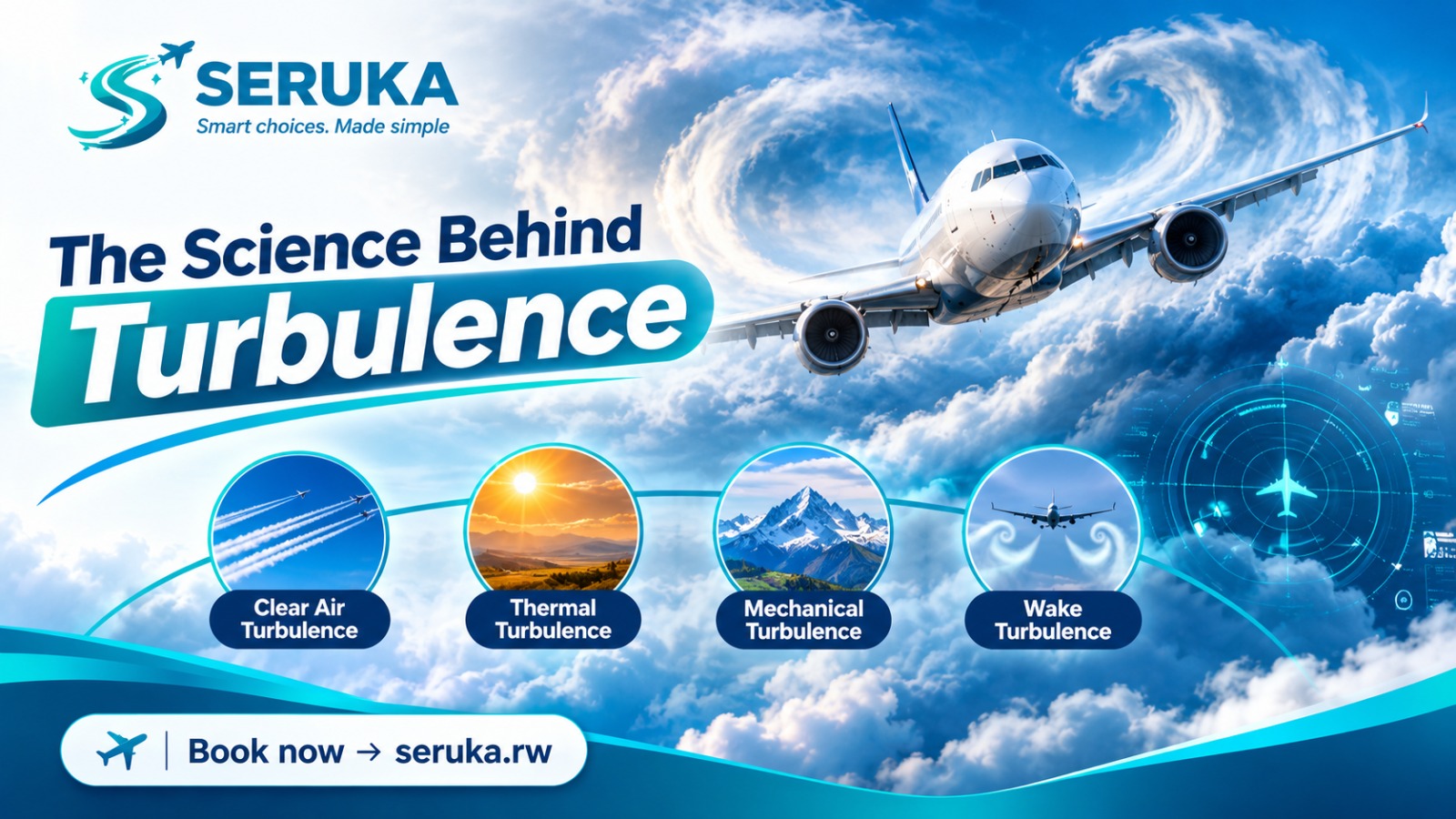
The Science Behind Turbulence
What really makes an aircraft shake in the sky? Discover the invisible forces behind bumpy flights and how aircraft and pilots handle them.
You are cruising comfortably above the clouds when suddenly your aircraft shakes. A drink begins to move on the tray table, the cabin vibrates, and the seatbelt sign switches on. For many passengers, turbulence is one of the most uncomfortable parts of flying.
But what is actually happening? Is the aircraft hitting something in the sky? Is the wind pushing it around? And how can a plane weighing hundreds of tonnes remain safe while moving through such rough air?
The answer begins with understanding that air is not always smooth or still. It moves in currents, waves and swirling patterns. When an aircraft passes through these changing air movements, it experiences turbulence.
01 What causes turbulence?
Air is a fluid, just like water. It can flow smoothly, but it can also form swirls, sudden changes in speed and irregular movements. These patterns can develop because of temperature differences, strong winds, mountains, buildings, weather systems or even another aircraft.
Pilots and meteorologists consider several types of turbulence. Four important examples help explain why a flight can become bumpy in very different situations.
02 Clear Air Turbulence (CAT)
The turbulence you may not see coming
Clear Air Turbulence, commonly called CAT, can occur in apparently clear skies without the obvious clouds or storms passengers might associate with bad weather. It is often found at higher altitudes, particularly near jet streams.
What causes it?Jet streams are narrow regions of fast-moving air high in the atmosphere. They can travel at very high speeds and form boundaries with surrounding air moving at different speeds or directions. Where these differences create strong wind shear, the atmosphere can become turbulent.
Imagine two rivers flowing beside each other at different speeds. The boundary between them can become unstable. A similar process can happen in the atmosphere, although the physics is more complex.
Why can it surprise passengers?Weather radar on an aircraft primarily detects precipitation, not clear-air turbulence itself. That means CAT may not appear on the cockpit weather radar. However, pilots and meteorologists use forecasts, turbulence reports from other aircraft and other weather information to assess the risk.
03 Thermal Turbulence
When the sun makes the air move
Have you noticed that flights can sometimes feel bumpier during warm daytime conditions, especially when flying over land? One possible reason is thermal turbulence, which develops through the uneven heating of the Earth's surface.
What causes it?The sun does not heat every surface equally. Roads, dry ground, forests, fields and lakes absorb and release heat differently. Air above a warmer surface becomes warmer and less dense, so it can rise. Cooler air moves down or sideways to replace it.
These rising and sinking air currents are part of a process called convection. When an aircraft passes through areas of changing vertical airflow, passengers may feel the aircraft gently move up and down.
Where is it more likely?Thermal turbulence is often associated with daytime heating over land. It can also occur near clouds and other areas of atmospheric convection. Stronger convective activity, especially thunderstorms, can produce much more dangerous turbulence and is avoided by pilots.
04 Mechanical Turbulence
When the landscape disturbs the wind
Wind does not always travel freely across the Earth's surface. Mountains, hills, cliffs and even large buildings can interrupt its movement. When air flows over or around these obstacles, it can form irregular currents and swirling eddies.
What causes it?Imagine water flowing through a river and meeting a large rock. The water changes direction, forms swirling patterns and becomes less predictable behind the obstacle. Wind behaves in a comparable way when it encounters terrain or structures.
The result can be rough air, especially close to the ground or downwind of obstacles. When strong winds cross mountain ranges, they can also produce mountain waves and, in some conditions, turbulent areas called rotors.
Why does it matter?These conditions can affect aircraft during approach, departure and flight near mountainous terrain. Pilots use weather forecasts, reports and operational procedures to assess and manage the conditions.
05 Wake Turbulence
The invisible trail left by another aircraft
Every aircraft producing lift creates a disturbance in the air behind it. This is known as wake turbulence. It is especially important because the disturbance can remain after the aircraft that created it has already moved away.
What causes it?As a wing generates lift, pressure differences around the wing cause air to roll into two rotating vortices that trail behind the aircraft, generally from the wingtips. These are called wingtip vortices.
The strength of these vortices is influenced by factors such as aircraft weight, wingspan and speed. A large, heavy aircraft can produce powerful wake vortices that may affect a smaller aircraft following behind.
How is it managed?Air traffic control applies separation procedures to reduce the risk of aircraft encountering another aircraft's wake. Pilots also consider the position and flight path of preceding aircraft, particularly during take-off and landing.
06 Are airplanes strong enough to handle turbulence?
Yes. Commercial aircraft are designed and certified to withstand demanding loads during flight. Their wings are not rigid structures; they are engineered to flex as aerodynamic forces change.
That flexibility is important. A wing that can bend under load helps distribute forces through the structure rather than behaving like a completely rigid object. Seeing a wing move during turbulence can look alarming from a passenger window, but flexing is an expected part of its design.
Before an aircraft enters service, its structure must meet strict certification requirements. Structural testing includes applying controlled loads to demonstrate that the airframe can withstand specified forces. In simplified terms, certification distinguishes between limit loads—the maximum loads expected in normal operations—and ultimate loads, which include an additional safety factor.
07 Does turbulence mean the aircraft is falling?
Not usually. A sudden bump or downward movement can feel like the aircraft is dropping, but the sensation does not necessarily mean it is losing significant altitude. Turbulence can cause short changes in acceleration and aircraft movement that your body feels very clearly.
Pilots classify turbulence by its intensity, based on how it affects the aircraft and people on board. Light turbulence may cause small, irregular movements. Moderate turbulence can make walking difficult and cause unsecured objects to move. Severe turbulence can produce large, abrupt changes in aircraft movement and may injure people or damage the aircraft. Extreme turbulence is rare and can exceed the aircraft's normal control capability.
This is why the seatbelt sign matters even when the sky looks clear. Unexpected turbulence can happen without much warning, and a securely fastened seatbelt helps prevent passengers from being thrown from their seats.
08 What should passengers do?
Simple ways to stay safer during turbulence
- Keep your seatbelt fastened whenever you are seated, even when the sign is off. Keep it comfortably snug and visible over your clothing.
- Follow crew instructions. Cabin crew are trained to respond to changing conditions.
- Secure loose items. Keep bags, electronics and other objects safely stowed when instructed.
- Stay seated when the seatbelt sign is on. Avoid walking around the cabin during turbulence unless there is an urgent need.
- Do not panic. Turbulence is a recognised part of flying, and pilots are trained to manage changing atmospheric conditions.
09 The takeaway
Turbulence is not one single phenomenon. It can develop from powerful jet streams, rising warm air, wind flowing over mountains and buildings, or the invisible vortices left behind another aircraft.
Although it can be uncomfortable and occasionally hazardous, aircraft are engineered for demanding flight conditions, and pilots use forecasts, reports, procedures and their training to manage the risks.
So the next time your aircraft shakes above the clouds, remember what is happening: you are travelling through an atmosphere that is constantly moving. The air may be uneven, but the aircraft is designed to operate in a changing environment.
Federal Aviation Administration (FAA)
SKYbrary Aviation Safety
National Weather Service
Your next journey starts here
Whether your next trip is for business or adventure, explore flight options and plan your journey with Seruka.
Book now → seruka.rw